
Hand Tools Quality Control Order (QCO): What Manufacturers Need to Know
Introduction
Manufacturers and importers of hand tools need to understand the applicable BIS certification requirements before supplying products to the Indian market. The Government of India has introduced the Hand Tools (Quality Control) Order, 2025, to make compliance with specified Indian Standards mandatory for covered products.
The order identifies nine categories of hand tools, including spanners, pipe wrenches and combination side-cutting pliers. Businesses dealing in these products should review the applicable standards, certification process and implementation requirements.
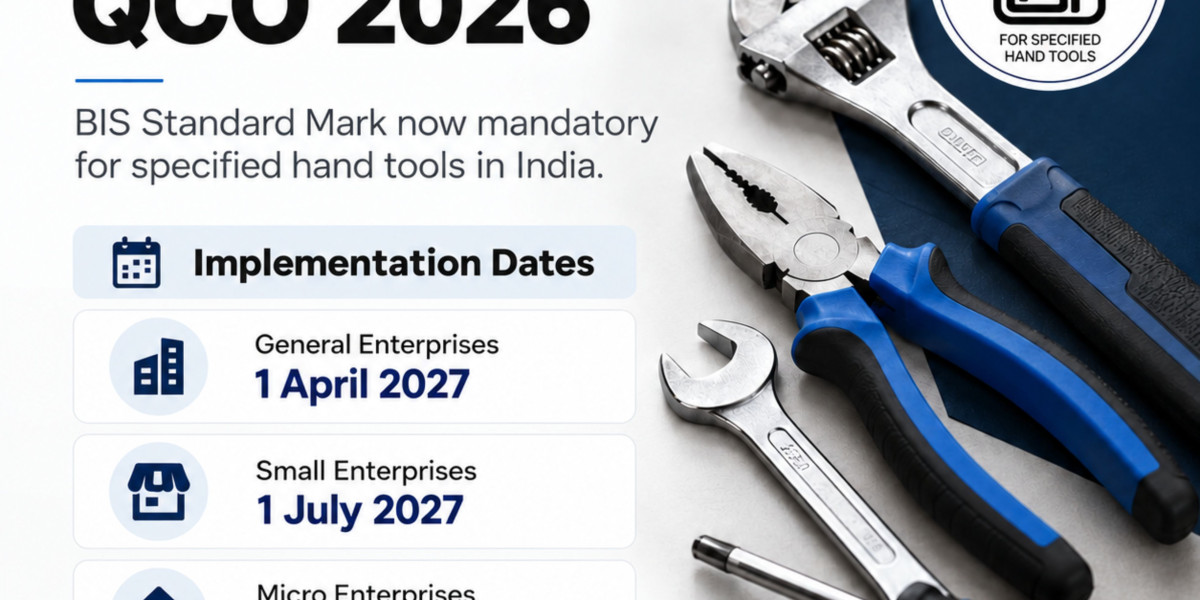
The latest notification, issued on 4 December 2025, supersedes the earlier Hand Tools (Quality Control) Order, 2025 and specifies an implementation date of 1 October 2026, with separate dates for small and micro enterprises for the product entry where these dates are expressly provided.
What Is the Hand Tools Quality Control Order?
A Quality Control Order (QCO) is a government notification that makes compliance with specified Indian Standards compulsory for the products covered under it.
The Hand Tools (Quality Control) Order, 2025 was issued by the Department for Promotion of Industry and Internal Trade (DPIIT), under the Ministry of Commerce and Industry, in accordance with the Bureau of Indian Standards Act, 2016.
Under the order, covered hand tools must conform to the relevant Indian Standard and bear the BIS Standard Mark under a licence granted by the Bureau of Indian Standards (BIS), following Scheme I of the BIS Conformity Assessment Regulations, 2018.
This means that manufacturers cannot rely only on their internal quality checks or supplier declarations. They must determine whether their products fall within the order and obtain the required certification when applicable.
Which Hand Tools Are Covered Under the QCO?
The notification lists nine hand tool categories and their corresponding Indian Standards.
| Hand tool category | Applicable Indian Standard |
|---|---|
| General-purpose pipe wrenches | IS 4003 (Part 1):1978 |
| Heavy-duty pipe wrenches | IS 4003 (Part 2):1986 |
| Open-jaw wrenches (spanners) | IS 2028:2004 |
| Ring wrenches (spanners) | IS 2029:1998 |
| Single-ended open-jaw adjustable wrenches | IS 6149:1984 |
| Chain pipe wrenches | IS 4123:1982 |
| Open-ended slugging wrenches (spanners) | IS 4508:1992 |
| Ring slugging wrenches (spanners) | IS 4509:1992 |
| Combination side-cutting pliers | IS 3650:1981 |
Manufacturers should verify the latest applicable editions and amendments of these standards, as specified in the notification.
Important: Not every product commonly described as a hand tool is automatically covered by this list. Businesses should identify the exact product category and its applicable Indian Standard before deciding whether certification is mandatory.
When Does the Hand Tools QCO Come Into Effect?
The revised notification dated 4 December 2025 states that the Hand Tools (Quality Control) Order, 2025 comes into force on 1 October 2026.
For general-purpose pipe wrenches covered by IS 4003 (Part 1):1978, the notification provides the following implementation dates:
| Enterprise category | Implementation date |
|---|---|
| General category, excluding micro and small enterprises | 1 October 2026 |
| Small enterprises | 1 January 2027 |
| Micro enterprises | 1 April 2027 |
The December 2025 notification does not expressly reproduce separate implementation dates for the other eight product entries in the table. Manufacturers dealing in those products should consult the complete Gazette notification and any subsequent amendments to confirm the applicable date and current requirements.
Businesses should also verify their MSME classification and eligibility for any applicable implementation extension rather than assuming that every manufacturer receives the same deadline.
What Does BIS Certification Mean for Hand Tool Manufacturers?
BIS certification provides a framework for demonstrating that a product complies with the applicable Indian Standard. Under a mandatory QCO, certification is a regulatory requirement for covered products once the relevant implementation date takes effect.
For manufacturers, this involves more than placing an ISI logo on packaging. The product must meet the applicable standard, the manufacturing facility and quality-control arrangements must satisfy BIS requirements, and the Standard Mark must be used in accordance with the licence.
For example, a manufacturer producing general-purpose pipe wrenches should first identify the applicable requirements under IS 4003 (Part 1). The manufacturer can then prepare the product, testing arrangements and factory quality-control documentation required for its BIS application.
The precise testing and inspection requirements depend on the applicable standard and BIS certification procedures.
How to Get BIS Certification for Hand Tools
Manufacturers can approach the certification process in the following stages.
1. Identify the Applicable Indian Standard
Begin by identifying the exact type of hand tool being manufactured. Check the QCO table and the corresponding Indian Standard.
This step is important because different tools may be governed by different standards. Applying the wrong standard can result in unnecessary testing, documentation errors or delays.
2. Review the Product Requirements
Review the relevant Indian Standard to understand the product specifications, performance requirements, dimensions, materials and tests applicable to the product.
The manufacturer should compare these requirements with the existing product design and manufacturing process. Any identified gaps should be addressed before proceeding with testing.
3. Prepare the Manufacturing and Quality Documents
Prepare the documentation required for the BIS application and factory assessment. Depending on the application and applicable requirements, this may include:
Manufacturing facility details
Product specifications and drawings
Manufacturing process information
Quality-control procedures
Testing equipment and calibration records
Details of raw materials and component inspection
Product test reports, where applicable
Business registration and other prescribed application documents
The final document list should be checked against the relevant BIS application requirements.
4. Arrange Product Testing
The product must be evaluated against the applicable Indian Standard. Manufacturers should coordinate testing through the appropriate laboratory and follow the requirements applicable to their certification application.
Testing should cover the relevant parameters specified in the standard. Businesses should not assume that a generic quality report or a test report for a similar product will automatically be accepted.
5. Submit the BIS Application
Submit the application and supporting information through the applicable BIS certification process.
Ensure that the product description, manufacturing details, standard reference and supporting documents are consistent. Incomplete information or discrepancies may require clarification and delay processing.
6. Complete Factory Assessment and Compliance Requirements
BIS may assess the manufacturing facility, production arrangements, in-process controls, testing capabilities and quality-control systems as part of the certification process.
Manufacturers should ensure that their production and inspection procedures are documented and that the required facilities and records are available.
7. Obtain the Licence Before Using the Standard Mark
After the applicable requirements are fulfilled and BIS grants the licence, the manufacturer must use the Standard Mark in accordance with the licence conditions.
The mark should not be applied merely because an application has been submitted or product testing has started.
What Should Importers and Foreign Manufacturers Know?
The Hand Tools QCO is relevant to importers as well as domestic manufacturers. Importing a product does not automatically exempt it from Indian product compliance requirements.
Importers should confirm whether the product is covered by the order, whether the overseas manufacturer holds the required BIS licence, and whether the product and manufacturing facility details match the scope of that licence.
Foreign manufacturers may need to apply under the Foreign Manufacturers Certification Scheme (FMCS), subject to the applicable BIS requirements.
Before placing purchase orders or arranging shipments, importers should verify the certification status and the applicable implementation date. This can help reduce the risk of delays, non-compliant stock or difficulties in selling the product in India.
Are There Any Exemptions Under the Hand Tools QCO?
The December 2025 notification provides certain specific exemptions.
Products manufactured domestically for export: The order states that its provisions do not apply to goods or articles manufactured domestically for export.
Certain research and development imports: The order provides an exemption for up to 200 imported goods or articles per year for research and development purposes by hand tool manufacturers. These goods must not be sold commercially, must be disposed of as scrap, and must be recorded year-wise. The records must be furnished to government authorities when requested.
These exemptions are subject to the exact conditions in the notification. Businesses should not assume that products imported for ordinary commercial sale or products made for the domestic market are exempt.
What Happens If a Manufacturer Does Not Comply?
Once the applicable QCO requirements take effect for a covered product, businesses must comply with the relevant certification and Standard Mark requirements.
The notification identifies BIS as the certification and enforcement authority and states that violations are punishable under the Bureau of Indian Standards Act, 2016.
Manufacturers and importers should therefore verify compliance before manufacturing, importing or selling affected products after the applicable deadline.
How Can Manufacturers Prepare Before the Deadline?
Businesses can take the following steps to prepare:
Audit the product range: Identify which hand tools fall within the nine listed categories.
Confirm the applicable standards: Match each product to the correct Indian Standard and check for amendments.
Verify implementation dates: Review the latest Gazette notification and subsequent amendments.
Review factory readiness: Assess product quality, testing arrangements and documented quality-control procedures.
Prepare the application documents: Organise the required business, manufacturing and technical information.
Plan testing and certification: Allow time for product evaluation, factory assessment and any corrective action.
Verify licence scope: Ensure the final BIS licence covers the correct product and manufacturing facility before using the Standard Mark.
Early preparation is particularly important for businesses with multiple tool categories or overseas manufacturing facilities.
How SS Global Services Can Help
SS Global Services provides regulatory compliance and product certification consultancy for manufacturers, importers and brand owners.
For businesses dealing in hand tools, support may include understanding the applicable BIS requirements, reviewing documentation, coordinating product testing and assisting with the certification application process.
The applicable requirements and certification route should be confirmed for the specific product before proceeding.
Visit SS Global Services to learn more about BIS certification and product compliance services in India.
Frequently Asked Questions
1. Is BIS certification mandatory for hand tools in India?
BIS certification is mandatory for hand tools covered by an applicable Quality Control Order once the relevant implementation date takes effect. Manufacturers should verify whether their specific product is covered.
2. Which hand tools are listed under the QCO?
The notification lists general-purpose and heavy-duty pipe wrenches, open-jaw spanners, ring spanners, adjustable wrenches, chain pipe wrenches, slugging spanners and combination side-cutting pliers.
3. What is the implementation date of the Hand Tools QCO 2025?
The revised order states 1 October 2026 as its commencement date. It also specifies later implementation dates for small and micro enterprises for general-purpose pipe wrenches under IS 4003 (Part 1):1978. The applicable dates for other listed products should be verified against the full notification and any amendments.
4. Can an importer sell hand tools without BIS certification?
An importer must comply with the applicable QCO requirements for covered products once the relevant implementation date takes effect. Importers should verify the manufacturer's BIS licence and its scope before arranging commercial imports.
5. Can a foreign manufacturer apply for BIS certification?
Yes. Foreign manufacturers may apply through the applicable BIS certification route, including FMCS where relevant, and must meet the prescribed requirements.
6. Does every hand tool require BIS certification?
No. The scope depends on the products and standards specified in the applicable QCOs. Businesses should verify the product category and relevant notification rather than assume that every hand tool is covered.
Conclusion
The Hand Tools Quality Control Order, 2025 is an important regulatory development for manufacturers, importers and suppliers dealing in specified hand tools in India. Businesses should identify the applicable Indian Standard, verify the implementation date, prepare their quality-control documentation and complete the relevant BIS certification requirements before the deadline applicable to their products.
Keeping track of official notifications and amendments can help businesses plan certification more effectively and avoid preventable compliance issues.