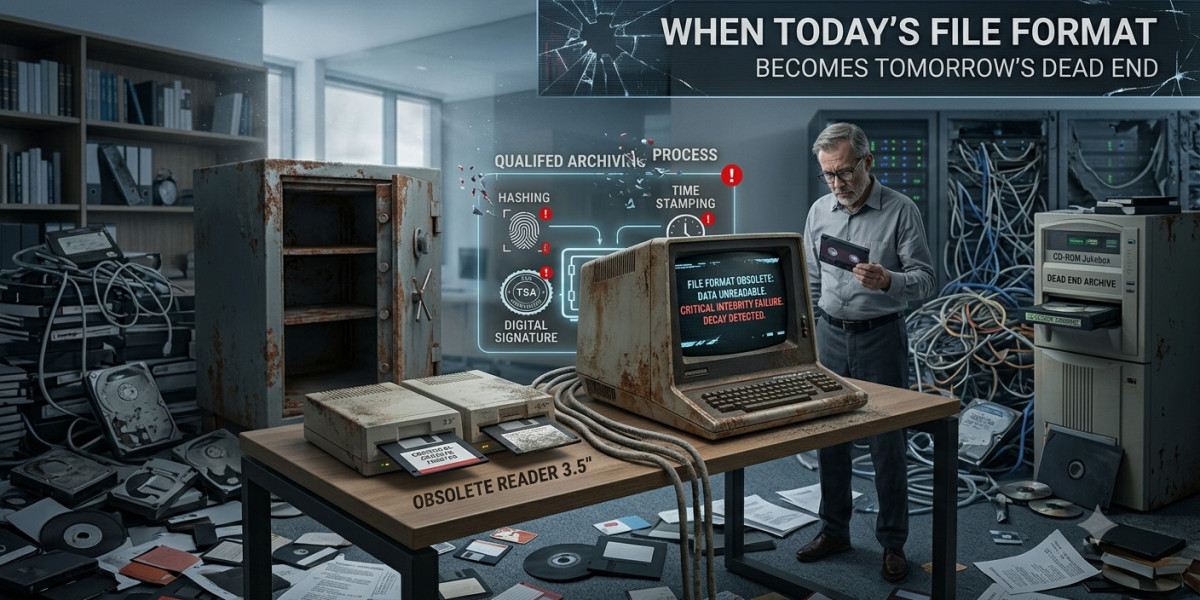

A digital file feels permanent. You can copy it endlessly, and every copy is identical to the original, which makes it easy to assume the file will be readable forever. It will not. A format that opens instantly today can become a dead end tomorrow, when the software that understood it is gone and nothing modern can interpret what is inside. The bits survive, but the meaning is locked away. Avoiding that outcome is one of the central jobs of long-term archiving.
This article explains why file formats reach a dead end, what it costs when they do, and how long-term archiving keeps records readable across the decades that would otherwise strand them.
Why File Formats Reach a Dead End
A file format becomes a dead end when the software and standards needed to read it disappear. The data is still there, but without a way to interpret it, it might as well be gone.
The False Sense of Permanence
The ease of copying digital files creates a dangerous illusion. Because an infinite number of identical copies can be made, many people assume their documents have an indefinite shelf life (Wikipedia, 2026).
Making perfect copies feels like preservation, but it only duplicates the format problem.
A thousand copies of an unreadable file are still unreadable.
Permanence depends on access, not on the number of copies.
How a Format Actually Dies
Formats rarely vanish overnight. They fade as the software around them moves on.
Applications are upgraded, and the ability to read older versions is quietly dropped.
Proprietary formats depend on a single vendor's software that may disappear.
The hardware needed to read older media can become impossible to find.
What a Dead Format Costs You
When a format dies, the records trapped in it are effectively lost, and history is full of expensive examples. They are worth remembering because the same risk applies to ordinary business records.
Records Already Lost to Obsolescence
Some well-documented losses show how real this is.
Andy Warhol's digital artworks, created on a 1980s Commodore Amiga, were stranded in an obsolete format for decades (Long Now Foundation, 2023).
MySpace lost millions of songs, videos, and photos during a botched data migration in 2019.
Even NASA's early space records have suffered repeated accessibility problems from obsolete formats.
Why This Applies to Your Records Too
The same forces that stranded those files threaten everyday business documents.
Contracts, records, and evidence held in older formats face the same decay.
A record you cannot open is a record you cannot use, audit, or defend.
The cost surfaces at the worst moment, during a dispute, audit, or retrieval request.
The Digital Dark Age, in Brief
The risk has a name. The term "digital dark age" was coined by Terry Kuny in 1997 to describe a future in which large amounts of digital information become inaccessible due to obsolescence and decay (Grokipedia, 2026).
It captures the fear that today's records could become tomorrow's unreadable artifacts.
It pushed archives and institutions to build deliberate preservation strategies.
It reframed preservation as an active duty, not a passive assumption.
How Long-Term Archiving Prevents the Dead End
Long-term archiving prevents format obsolescence through deliberate, ongoing action rather than hope. The methods are well established and used by national archives worldwide.
Choose Formats Built to Last
The first defence is selecting formats designed for preservation, not just convenience.
Open, non-proprietary formats avoid dependence on a single vendor.
Standards such as PDF/A are designed to stay readable for the long term.
Several national archives accept formats like PDF and OpenDocument for preservation.
Migrate Before Formats Die
Migration moves records from aging formats into current ones before the old formats become unreadable.
It transfers data into formats that modern systems can interpret.
Tools and registries such as PRONOM help identify viable migration paths.
Planned migration treats format change as routine maintenance, not an emergency.
Verify Integrity After Every Migration
Migration is powerful but not risk-free, which is why verification matters.
Any transformation of data can introduce errors or subtle loss of information.
Integrity checks confirm the migrated record still matches the original.
The original is retained alongside the new version as a safeguard.
Monitor Format Risk Continuously
A real archive watches for obsolescence rather than waiting for it.
Format identification tools such as DROID and PRONOM flag at-risk records.
Continuous monitoring means action is taken before a format dies, not after.
Preservation becomes a managed process running quietly in the background.
A Balanced View of the Risk
It is worth being honest about the scale of the problem. Preservation specialists increasingly note that format obsolescence is not always as severe as once feared, and many established formats remain supported for years (Digital Preservation Coalition).
The point is not panic, but planning.
Some formats are stable, while others carry real risk, so selection matters.
A sound strategy mitigates obsolescence without overreacting to it.
This measured approach is exactly what good long-term archiving provides: enough vigilance to prevent dead ends, without treating every file as a crisis.
Conclusion
When today's file format becomes tomorrow's dead end, the loss is quiet and complete. The data survives, but the ability to read it does not, and no number of copies can fix a format the world has forgotten how to open.
Long-term archiving prevents that outcome by choosing durable formats, migrating records before old ones die, verifying integrity at every step, and monitoring format risk continuously. The goal is simple but demanding: to make sure a record created today can still be opened, read, and trusted decades from now, long after the software that made it has become history.