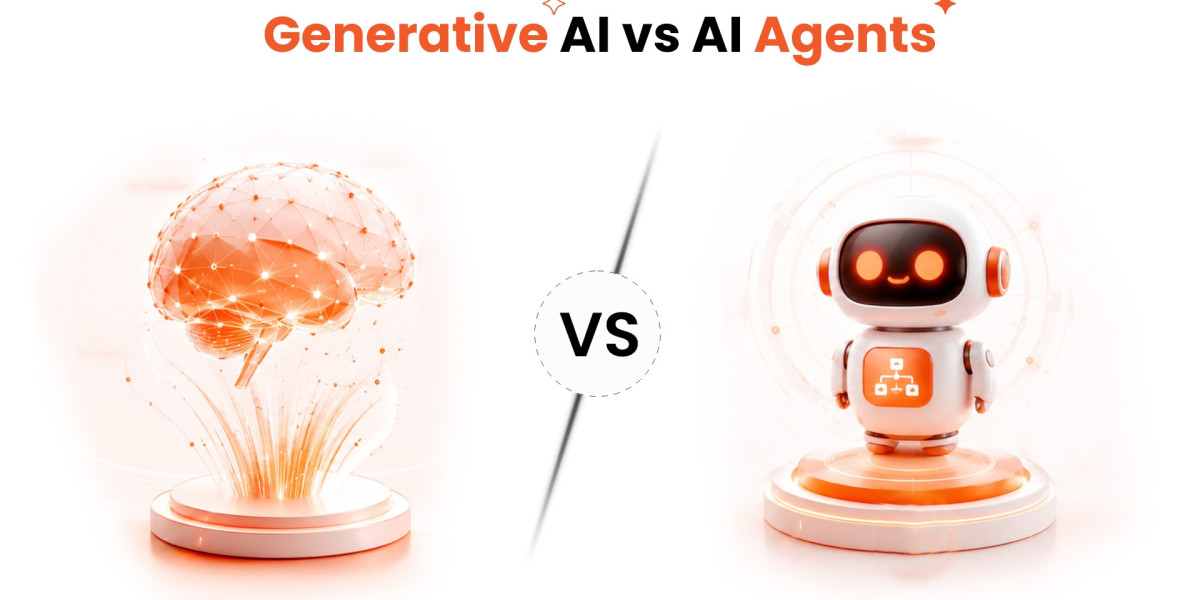

Artificial Intelligence is evolving rapidly, and businesses are no longer asking Should we adopt AI? But rather which AI approach is right for our business needs?
With the rise of Generative AI, Agentic AI, and Hybrid AI models, enterprises now have multiple ways to improve productivity, automate operations, and create smarter customer experiences. Understanding the difference between these AI approaches is essential for choosing the right strategy.
What is Generative AI?
Generative AI focuses on creating new content based on user inputs and learned patterns. It can generate text, images, code, summaries, reports, and other forms of digital content.
Popular enterprise use cases of Generative AI include:
- Creating marketing content and business documents
- Generating software code and technical documentation
- Automating customer responses
- Summarizing large volumes of information
- Supporting research and decision-making
For example, an AI-powered content assistant can help marketing teams create campaigns faster, while an AI coding assistant can improve developer productivity.
What is Agentic AI?
Agentic AI takes AI capabilities a step further by enabling systems to plan, make decisions, and execute tasks autonomously. Instead of only responding to prompts, AI agents can analyze situations, perform multiple actions, and work toward specific goals.
Common applications of Agentic AI include:
- Automating complex business workflows
- Managing supply chain operations
- Handling customer support processes
- Performing data analysis and generating insights
- Executing repetitive operational tasks
For example, an AI logistics agent can monitor inventory, predict demand, identify delivery issues, and recommend actions without constant human intervention.
When Should Enterprises Use a Hybrid AI Model?
A Hybrid AI approach combines the strengths of both Generative AI and Agentic AI.
While Generative AI helps create insights and content, Agentic AI helps take action based on those insights. Together, they create a more powerful AI ecosystem.
Examples of Hybrid AI applications:
- Customer support systems that understand customer queries, generate responses, and automatically resolve issues
- Sales platforms that analyze customer behavior and recommend next steps
- Enterprise assistants that create reports and trigger business workflows
A hybrid AI model is ideal for organizations looking to build intelligent systems that can both think and act.
Generative AI vs Agentic AI vs Hybrid AI: Making the Right Choice
The right AI approach depends on your business objectives:
1. Need faster content creation? → Generative AI
2. Need intelligent automation and autonomous workflows? → Agentic AI
3. Need complete AI-powered business transformation? → Hybrid AI
Enterprises should evaluate their processes, data infrastructure, security requirements, and automation goals before selecting an AI strategy.
The Future of Enterprise AI
The future of AI is not about choosing only one technology. Businesses will increasingly combine different AI capabilities to build smarter, faster, and more adaptive solutions.
Generative AI will continue to enhance human creativity, while Agentic AI will transform how organizations automate decisions and operations. Hybrid AI models will bridge the gap by creating end-to-end intelligent systems. So if you want to know more about Generative AI vs Agentic AI then need to explore deeply.
For enterprises planning their AI journey, understanding these AI approaches is the first step toward building scalable and future-ready solutions.