
Email marketing remains one of the most effective ways to connect with healthcare professionals. However, reaching anesthesiologists and encouraging them to respond requires a thoughtful approach. These professionals work in demanding environments and receive numerous emails every day, making it essential for marketers to stand out with relevant and valuable communication.
An Anesthesiologists Email List can help businesses reach the right audience, but success depends on how campaigns are planned and executed. Simply sending emails is not enough. To improve response rates, marketers must focus on personalization, relevance, timing, and trust.
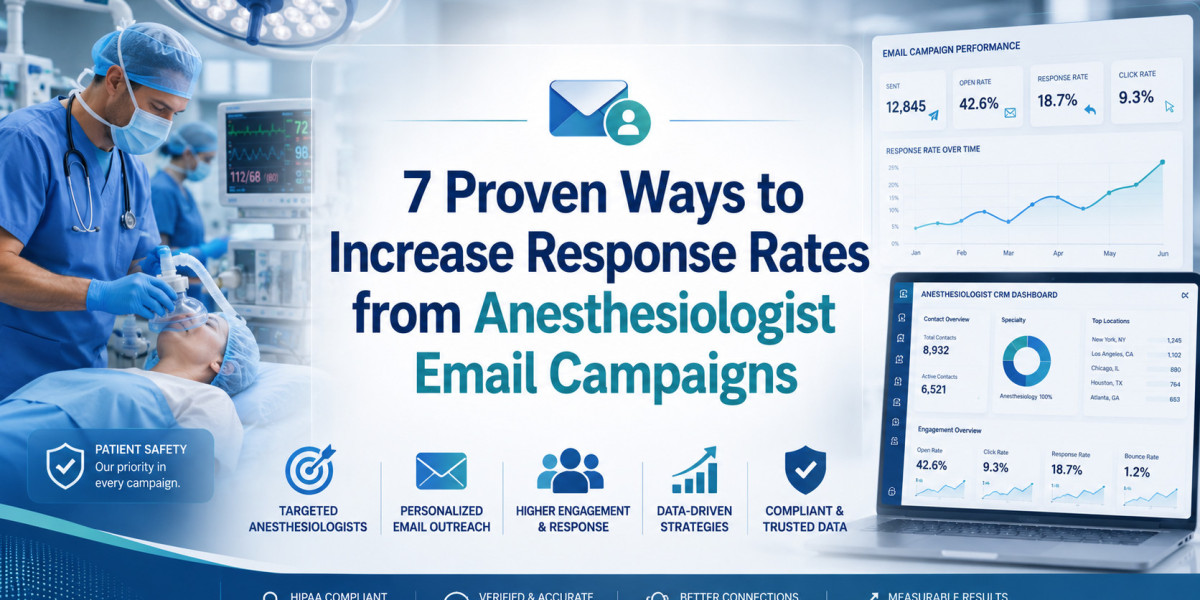
In this article, we will explore seven proven ways to increase response rates from anesthesiologist email campaigns while making the most of your marketing efforts.
Why Response Rates Matter
Response rates are an important indicator of campaign success. A higher response rate often means that your content is reaching the right people and providing value.
Strong response rates can help businesses:
Generate qualified leads
Build professional relationships
Increase brand awareness
Improve return on investment
Support long-term business growth
By focusing on engagement rather than volume, marketers can achieve better results with fewer resources.
1. Use Accurate and Verified Contact Data
The foundation of every successful email campaign is quality data. If emails are sent to outdated or incorrect addresses, response rates will suffer.
A reliable database should include:
Verified email addresses
Current job titles
Accurate professional information
Updated workplace details
Regularly cleaning and updating your contact database helps ensure that emails reach active anesthesiologists who are more likely to engage.
Accurate data also improves deliverability and protects your sender reputation.
2. Personalize Every Email
Personalization is one of the simplest ways to improve engagement.
Medical professionals are more likely to respond when emails feel relevant to their needs and interests.
Personalization can include:
Using the recipient's name
Mentioning their specialty
Referencing their professional role
Sharing relevant industry content
A personalized email feels more professional and less like mass marketing.
Even small personalization efforts can significantly increase response rates.
3. Focus on Providing Value
Anesthesiologists are busy professionals who prioritize useful information.
Instead of sending purely promotional emails, focus on delivering value.
Examples include:
Clinical insights
Industry news
Research updates
Educational resources
Best practice recommendations
When recipients perceive your content as valuable, they are more likely to engage with it and take action.
Value-driven communication builds trust over time.
4. Write Strong and Clear Subject Lines
The subject line plays a key role in determining whether recipients open an email.
A good subject line should:
Be concise
Highlight a benefit
Create interest
Remain professional
Examples include:
New Trends in Anesthesia Care
Improving Efficiency in Surgical Settings
Insights for Modern Anesthesiology Teams
Avoid misleading or overly promotional language, as it can reduce trust and hurt open rates.
Clear subject lines often lead to stronger engagement.
5. Segment Your Audience
Not all anesthesiologists have the same interests or responsibilities.
Audience segmentation helps deliver more relevant messages.
You can segment contacts based on:
Geographic location
Hospital affiliation
Experience level
Professional interests
Previous engagement behavior
Segmented campaigns typically perform better because the content matches the audience's specific needs.
Relevance is a major factor in improving response rates.
6. Optimize Timing and Email Frequency
Timing is a crucial factor in determining email campaign performance.
Even excellent content can be overlooked if it arrives at the wrong time.
Best practices include:
Testing different send times
Monitoring engagement data
Avoiding excessive email frequency
Maintaining a consistent schedule
Sending emails too frequently can cause audience fatigue and increase unsubscribe rates.
Finding the right balance helps maintain engagement and improves responses.
7. Include a Clear Call to Action
Every email should have a purpose.
A clear call to action helps guide recipients toward the next step.
Examples include:
Download a resource
Register for a webinar
Request more information
Read an industry report
Schedule a consultation
The call to action should be simple, direct, and easy to follow.
Avoid overwhelming recipients with multiple requests in a single email.
A focused message often leads to stronger responses.
Build Trust Through Consistency
Trust is one of the most important factors in healthcare marketing.
Anesthesiologists are more likely to respond when they recognize your organization as a reliable source of information.
Ways to build trust include:
Sharing accurate information
Maintaining a professional tone
Providing evidence-based content
Respecting privacy preferences
Being transparent in communication
Trust develops gradually but contributes significantly to long-term engagement.
Measure and Improve Campaign Performance
Successful marketers continuously monitor results and make improvements.
Key metrics to track include:
Open rates
Click-through rates
Response rates
Bounce rates
Unsubscribe rates
Analyzing performance data helps identify opportunities for optimization.
Small improvements over time can produce significant gains in campaign effectiveness.
Common Mistakes That Reduce Response Rates
Avoiding common mistakes can improve campaign outcomes.
These mistakes include:
Using outdated contact information
Sending generic emails
Ignoring audience segmentation
Overloading recipients with emails
Failing to provide value
Addressing these issues can help increase engagement and strengthen relationships with healthcare professionals.
The Future of Anesthesiologist Email Marketing
Email marketing continues to evolve with advancements in technology.
Emerging trends include:
Artificial intelligence for personalization
Predictive audience analysis
Automated lead nurturing
Real-time engagement tracking
Advanced audience segmentation
These innovations help marketers create more effective and relevant campaigns.
Organizations that embrace data-driven strategies will be better positioned for future success.
Conclusion
Increasing response rates from anesthesiologist email campaigns requires more than simply sending messages to a large audience. Success comes from using accurate data, personalizing communication, delivering valuable content, optimizing timing, and maintaining trust throughout the customer journey.
By implementing these seven proven strategies, businesses can improve engagement, generate more qualified opportunities, and achieve stronger marketing results.
In conclusion, a well-maintained Anesthesiologists mailing List combined with thoughtful and targeted email campaigns can help organizations connect with healthcare professionals more effectively while maximizing their marketing return on investment.