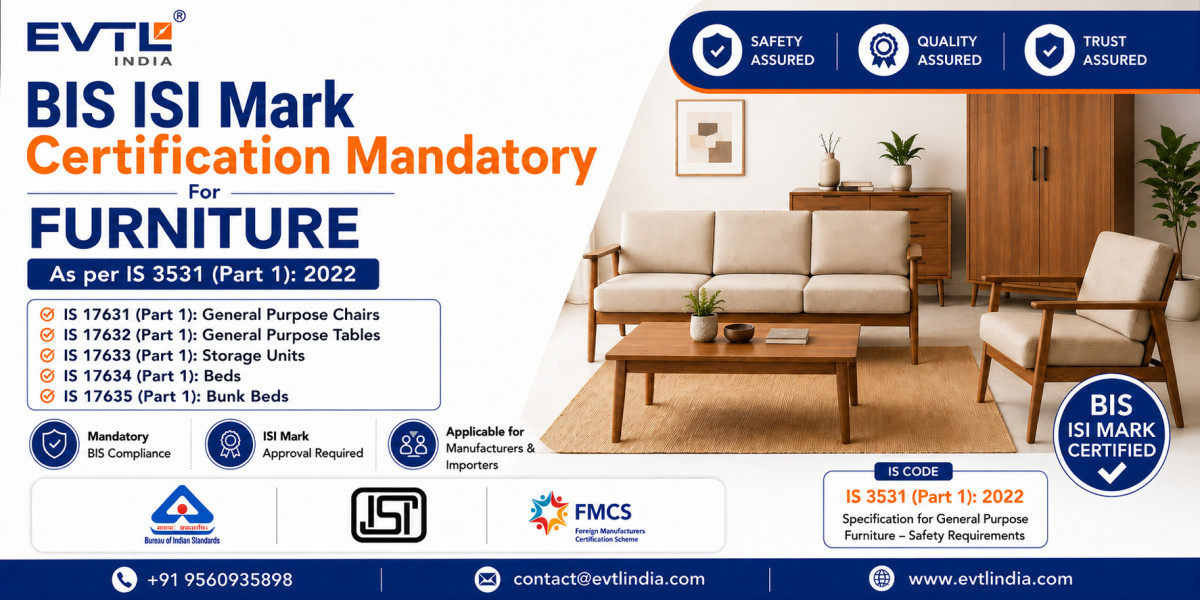

The Indian furniture industry has evolved rapidly over the last few years, with increasing demand for high-quality, durable, and safe products. To ensure that furniture products meet uniform quality benchmarks, the Government of India has introduced mandatory quality regulations through the Furniture QCO. Under this framework, specified furniture products must obtain BIS Certification for Furniture and carry the ISI Mark for Furniture before they can be sold in the Indian market.
For manufacturers and importers, obtaining Certification for Furniture is not only a legal requirement but also a strategic step toward building consumer confidence and expanding business opportunities. Compliance with the relevant IS Standards for Furniture demonstrates a commitment to quality and product reliability.
Understanding BIS Certification for Furniture
BIS Certification is a quality assurance mechanism administered by the Bureau of Indian Standards (BIS). It ensures that products comply with the technical and safety requirements specified under Indian Standards.
In the furniture sector, BIS Certification verifies that products meet essential criteria related to:
- Safety
- Strength
- Stability
- Durability
- Performance
- Structural integrity
Once a manufacturer successfully completes the certification process, they are permitted to use the ISI Mark, which serves as proof that the product complies with the prescribed standards.
What is the Furniture QCO?
The Furniture Quality Control Order (Furniture QCO) is a regulatory initiative aimed at improving the quality of furniture products available in the Indian market.
The objectives of the Furniture QCO include:
- Ensuring consumer safety.
- Promoting quality manufacturing.
- Establishing uniform industry standards.
- Reducing the circulation of substandard products.
- Supporting fair competition among manufacturers.
Under this order, furniture products falling within the notified categories must comply with the applicable Indian Standard and obtain BIS certification.
IS Standards for Furniture
The Furniture QCO specifies different Indian Standards for various categories of furniture.
IS 17631: 2022 – Work Chairs
IS 17631: 2022 covers work chairs used in offices and commercial environments. The standard includes requirements for:
- Mechanical strength
- Stability
- Durability
- Safety performance
- Functional reliability
IS 17632: 2022 – General Purpose Chairs and Stools
IS 17632: 2022 applies to chairs and stools intended for general use in homes, institutions, and commercial spaces.
The standard evaluates:
- Structural strength
- Load capacity
- Stability
- Safety
- Durability
IS 17633: 2022 – Tables and Desks
IS 17633: 2022 establishes performance requirements for tables and desks used in domestic and commercial applications.
Key aspects include:
- Stability testing
- Strength assessment
- Durability evaluation
- Safety verification
IS 17634: 2022 – Storage Units
IS 17634: 2022 applies to storage furniture, including wardrobes, cabinets, and shelving systems.
The standard ensures:
- Safe operation
- Structural integrity
- Long-term durability
- Resistance to regular usage
IS 17635: 2022 – Beds
IS 17635: 2022 specifies quality requirements for beds intended for residential and institutional applications.
Testing includes:
- Stability
- Structural performance
- Durability
- Safety
IS 17636: 2022 – Bunk Beds
IS 17636: 2022 focuses on bunk beds and includes additional requirements for:
- Guard rails
- Ladder safety
- Fall prevention
- Structural stability
These standards collectively form the essential IS Standards for Furniture under the Furniture QCO.
Why is Certification for Furniture Necessary?
Obtaining Certification for Furniture offers numerous advantages to businesses and consumers alike.
Compliance with Regulations
Manufacturers and importers can legally market regulated furniture products in India.
Enhanced Consumer Trust
The ISI Mark assures buyers that the product has been tested for quality and safety.
Better Product Quality
The certification process encourages systematic quality control during manufacturing.
Increased Market Opportunities
Certified products often gain wider acceptance in retail and institutional markets.
Competitive Advantage
Compliance with BIS standards can strengthen a brand's reputation and credibility.
Who Should Obtain BIS Certification?
The requirement for BIS Certification generally applies to:
- Domestic manufacturers.
- Foreign manufacturers exporting to India.
- Importers.
- Brand owners.
- Contract manufacturers.
- Private label businesses.
Businesses dealing with regulated furniture products should determine the applicable standards and certification requirements.
BIS Certification Process for Furniture
The process for obtaining BIS Certification involves multiple stages.
Product Classification
The manufacturer identifies the applicable Indian Standard for the product.
Documentation
Required documents relating to the company and manufacturing process are prepared.
Laboratory Testing
Product samples are tested to verify compliance with the relevant standard.
BIS Application
The application is submitted along with technical and administrative documents.
Factory Evaluation
BIS may conduct a factory inspection to assess manufacturing capabilities and quality control systems.
Licence Approval
After satisfactory evaluation, BIS grants the licence to use the ISI Mark.
Post-Certification Compliance
Manufacturers must maintain quality standards and comply with periodic inspections.
Documents Required
Manufacturers typically need to provide:
- Company registration documents.
- Factory licence.
- Manufacturing process details.
- Product specifications.
- Machinery list.
- Quality control procedures.
- Calibration records.
- Test reports.
- Factory layout.
- Authorized signatory documents.
- Additional BIS-required information.
Product Testing Under BIS Certification
Testing plays a crucial role in ensuring compliance with the relevant standard.
Furniture products may undergo evaluations for:
- Static load performance.
- Impact resistance.
- Stability.
- Strength.
- Fatigue resistance.
- Durability.
- Structural safety.
- Functional performance.
Testing helps verify that products can withstand normal usage conditions while maintaining safety and reliability.
Importance of the ISI Mark for Furniture
The ISI Mark for Furniture is one of the most recognized quality symbols in India.
It signifies that:
- The product complies with the relevant Indian Standard.
- Manufacturing processes are regularly monitored.
- Quality control measures are maintained.
- The manufacturer adheres to BIS requirements.
The ISI Mark helps consumers identify certified products and make informed purchasing decisions.
Common Challenges in BIS Certification
Manufacturers may face several practical challenges, including:
- Selecting the correct IS Standard.
- Understanding technical specifications.
- Preparing extensive documentation.
- Coordinating testing activities.
- Managing factory inspections.
- Maintaining ongoing compliance.
Early planning and professional support can help address these challenges effectively.
EVTL India's Role in Furniture BIS Certification
EVTL India is one of the leading BIS consultants in India, helping manufacturers obtain their BIS licences hassle-free.
EVTL India assists businesses with:
- Applicability assessment.
- Product classification.
- Documentation support.
- BIS application filing.
- Laboratory coordination.
- Factory audit preparation.
- Compliance management.
- End-to-end certification assistance.
Their expertise enables manufacturers and importers to navigate the certification process efficiently and meet regulatory requirements with confidence.
Conclusion
The introduction of the Furniture QCO reflects India's commitment to improving the quality and safety of furniture products available in the market. Through BIS Certification for Furniture, manufacturers and importers can demonstrate compliance with the prescribed IS Standards for Furniture, including IS 17631: 2022, IS 17632: 2022, IS 17633: 2022, IS 17634: 2022, IS 17635: 2022, and IS 17636: 2022.
Obtaining Certification for Furniture and using the ISI Mark for Furniture provides legal compliance, enhances consumer confidence, and supports sustainable business growth. As regulatory requirements continue to evolve, businesses that prioritize quality and certification will be better positioned to succeed in the competitive furniture industry. With expert assistance from EVTL India, manufacturers can simplify the BIS certification journey and focus on delivering high-quality products to the market.
Frequently Asked Questions
1. What is BIS Certification for Furniture?
It is a conformity assessment process that ensures specified furniture products comply with Indian quality and safety standards.
2. What is the Furniture QCO?
The Furniture QCO is a government regulation that mandates BIS certification for specified categories of furniture products.
3. Which standards are covered under the Furniture QCO?
The major standards include IS 17631: 2022, IS 17632: 2022, IS 17633: 2022, IS 17634: 2022, IS 17635: 2022, and IS 17636: 2022.
4. Why is the ISI Mark for Furniture important?
The ISI Mark indicates that a furniture product complies with the applicable BIS standard and quality requirements.
5. How can EVTL India help with Certification for Furniture?
EVTL India provides end-to-end assistance with documentation, product testing coordination, BIS application filing, factory audit support, and overall compliance management for furniture manufacturers and importers.