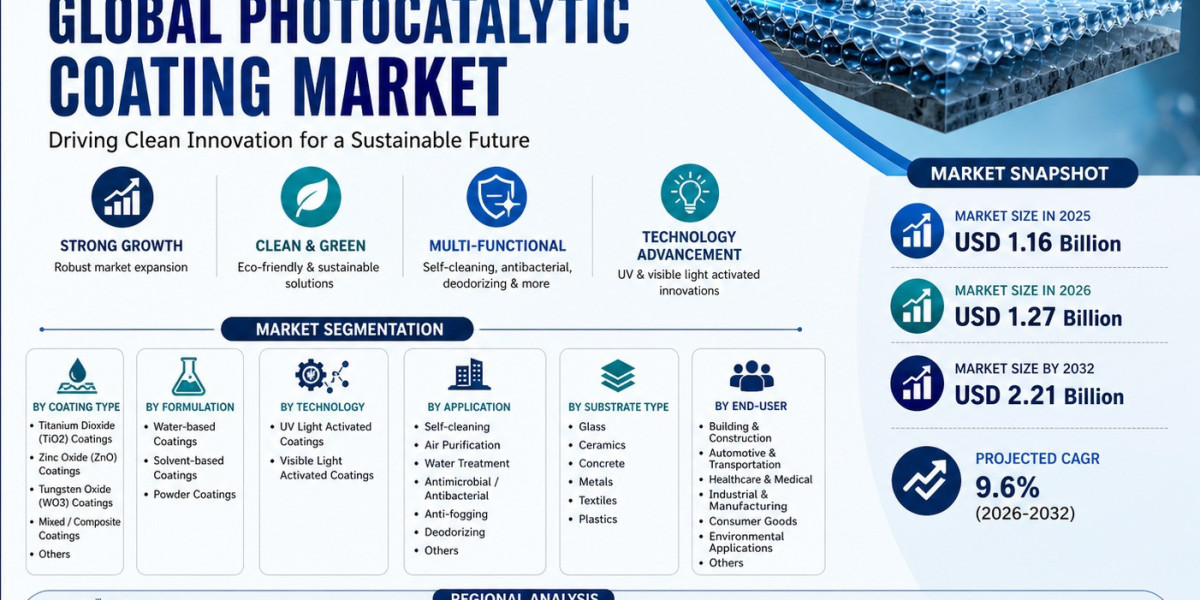

The global Photocatalytic Coating Market is witnessing significant growth due to increasing demand for sustainable construction materials, rising environmental concerns, and growing adoption of self-cleaning and air-purifying technologies across industries. Photocatalytic coatings are becoming an important part of modern infrastructure because they help improve surface hygiene, reduce pollution, and lower long-term maintenance requirements.
Rapid urbanization and industrial development across the world have increased concerns regarding air pollution, poor indoor air quality, and surface contamination. Governments, businesses, and consumers are therefore looking for innovative materials that support environmental sustainability while improving public health and infrastructure efficiency. Photocatalytic coatings are emerging as a highly effective solution because they use light-activated chemical reactions to break down pollutants, bacteria, organic contaminants, and harmful substances from surfaces and surrounding air.
The market is also benefiting from the growing focus on smart cities, green buildings, and eco-friendly infrastructure development. Construction companies, automotive manufacturers, healthcare facilities, and industrial organizations are increasingly adopting advanced coating technologies to improve sustainability and operational efficiency. As awareness regarding environmentally friendly materials continues rising, the Photocatalytic Coating Market is expected to witness strong long-term growth globally.
Understanding the Photocatalytic Coating Market
Photocatalytic coatings are specialized surface coatings that contain photocatalyst materials, most commonly titanium dioxide (TiO₂). When exposed to light, these materials trigger chemical reactions that help decompose pollutants, remove organic contaminants, purify air, and prevent bacterial growth on surfaces.
These coatings are widely applied across building facades, glass panels, concrete structures, automotive surfaces, medical devices, industrial equipment, and public infrastructure projects. Their ability to maintain cleaner surfaces and reduce environmental pollution makes them highly valuable in both residential and commercial applications.
One of the major advantages of photocatalytic coatings is their self-cleaning functionality. Dirt, dust, and organic matter can be broken down and washed away naturally when exposed to sunlight and moisture. This helps reduce cleaning and maintenance costs for buildings and infrastructure projects.
Another important benefit is air purification. Photocatalytic coatings can break down harmful pollutants such as nitrogen oxides (NOx) and volatile organic compounds (VOCs), helping improve both indoor and outdoor air quality. In healthcare and public infrastructure environments, these coatings also offer antimicrobial properties that help create safer and more hygienic surfaces.
As industries increasingly prioritize sustainability, energy efficiency, and low-maintenance materials, the demand for photocatalytic coatings continues to grow rapidly.
Key Growth Drivers of the Photocatalytic Coating Market
Rising Demand for Green Buildings
The global construction industry is increasingly focusing on sustainable building materials and environmentally responsible infrastructure development. Governments and urban planners are promoting green building standards that improve energy efficiency, reduce environmental impact, and support healthier living environments.
Photocatalytic coatings contribute to sustainable construction by reducing pollution, lowering maintenance requirements, and improving air quality around buildings. These coatings also support green building certification programs, making them highly attractive for modern commercial and residential projects.
The growing development of smart cities and sustainable urban infrastructure is expected to further increase adoption of photocatalytic surface technologies in the coming years.
Growing Concerns Regarding Air Pollution
Air pollution has become one of the most serious environmental challenges worldwide, especially in rapidly urbanizing regions. Increasing industrial emissions, vehicle pollution, and construction activities are negatively affecting public health and environmental quality.
Photocatalytic coatings help reduce harmful pollutants by breaking down nitrogen oxides, volatile organic compounds, and other airborne contaminants when exposed to light. This capability is making these coatings increasingly important for urban infrastructure projects, tunnels, highways, public buildings, and transportation systems.
As governments continue implementing stricter environmental regulations and pollution control measures, demand for air-purifying surface technologies is expected to rise significantly.
Increasing Focus on Hygiene and Antimicrobial Surfaces
The growing emphasis on hygiene and infection control is another major factor driving market growth. Hospitals, healthcare facilities, commercial spaces, educational institutions, and public transportation systems are increasingly adopting antimicrobial and self-sanitizing surface technologies.
Photocatalytic coatings help prevent bacterial growth and reduce contamination on frequently touched surfaces. Their antimicrobial properties make them highly valuable in healthcare settings where maintaining clean and hygienic environments is critical.
The increasing awareness regarding public hygiene and surface safety is expected to continue supporting strong market expansion across healthcare and commercial sectors.
Technological Advancements in Photocatalytic Coatings
The Photocatalytic Coating Market is evolving rapidly due to continuous advancements in nanotechnology, smart materials, and coating formulations.
Nanotechnology integration is significantly improving the performance of photocatalytic coatings. Nano-engineered coatings offer enhanced catalytic efficiency, improved transparency, greater durability, and faster pollutant degradation capabilities. These advancements are helping manufacturers develop more effective and commercially viable coating solutions.
Manufacturers are also developing advanced titanium dioxide formulations capable of activating under visible light instead of relying only on ultraviolet light. This is an important innovation because it expands the usability of photocatalytic coatings in indoor and low-light environments.
Another major trend is the integration of photocatalytic systems with smart building technologies and sustainable urban infrastructure materials. Modern smart surfaces are increasingly designed to support energy efficiency, pollution reduction, and intelligent environmental management systems.
As research and development activities continue growing, future photocatalytic coatings are expected to become more efficient, durable, and versatile across multiple applications.
Market Segmentation Analysis
The Photocatalytic Coating Market can be segmented based on material type, application, and coating functionality.
Titanium dioxide currently dominates the market because of its high photocatalytic efficiency, commercial availability, and strong environmental performance. Zinc oxide is also gaining popularity because of its antimicrobial and UV-resistant properties. Other advanced nanomaterials and semiconductor-based photocatalysts are emerging as next-generation solutions for specialized industrial applications.
By application, the construction sector represents the largest market segment due to increasing demand for self-cleaning buildings, sustainable infrastructure, and pollution-reducing urban materials. Modern architectural projects increasingly incorporate photocatalytic coatings on concrete surfaces, glass facades, and exterior walls to improve environmental performance and reduce maintenance costs.
The automotive industry is another important application area. Automotive manufacturers are using photocatalytic coatings for anti-fogging systems, self-cleaning vehicle surfaces, and air purification technologies. As sustainable automotive technologies continue evolving, demand for advanced coatings is expected to increase.
Healthcare applications are also witnessing rapid growth because of rising demand for antimicrobial and hygiene-focused surface solutions. Industrial sectors are increasingly adopting photocatalytic coatings in machinery, manufacturing facilities, and pollution control systems to improve durability and environmental efficiency.
Regional Market Insights
Europe Leading Sustainable Construction Adoption
Europe currently dominates the Photocatalytic Coating Market due to strong environmental regulations, green building initiatives, and large-scale investments in sustainable infrastructure development. Countries such as Germany, Italy, and France are major contributors to regional market growth because of their focus on urban pollution reduction and eco-friendly construction technologies.
The region’s strong emphasis on carbon reduction and environmental sustainability is creating favorable opportunities for advanced coating manufacturers.
Asia-Pacific Emerging as a High-Growth Market
The Asia-Pacific region is witnessing rapid market expansion because of increasing urbanization, infrastructure development, and rising environmental awareness. Governments across China, Japan, South Korea, and India are investing heavily in smart city projects and pollution control technologies.
Rapid industrialization and growing construction activities are increasing demand for sustainable building materials and air-purifying surface technologies across the region.
North America Supporting Advanced Building Technologies
North America remains an important market due to growing adoption of smart building technologies, modernization of healthcare infrastructure, and increasing demand for sustainable materials. The United States continues investing in advanced coating technologies and environmentally friendly construction solutions.
The region’s focus on innovation and technological advancement is expected to support steady market growth in the coming years.
Challenges in the Photocatalytic Coating Market
Despite strong growth opportunities, the market faces several challenges. One of the major concerns is the relatively high initial cost associated with advanced photocatalytic coatings. Specialized materials, nanotechnology integration, and advanced application processes can increase overall project expenses, which may limit adoption in cost-sensitive markets.
Limited awareness regarding the long-term benefits of photocatalytic coatings is another challenge, particularly in emerging economies. Many businesses and consumers remain unfamiliar with the maintenance savings, environmental advantages, and air purification capabilities offered by these technologies.
Performance limitations in low-light environments also remain a technical challenge for some coating systems. Since certain photocatalytic coatings require ultraviolet light exposure for optimal performance, manufacturers are investing heavily in visible-light-activated technologies to improve efficiency across different conditions.
Emerging Opportunities in the Photocatalytic Coating Market
The rapid growth of smart city infrastructure projects is creating significant opportunities for photocatalytic coating manufacturers. Governments worldwide are investing in pollution-reducing urban infrastructure, sustainable transportation systems, and environmentally friendly construction technologies.
Healthcare and public hygiene applications are also emerging as major growth areas. Hospitals, airports, schools, shopping malls, and public transportation facilities increasingly require self-sanitizing and antimicrobial surfaces to improve public safety and hygiene standards.
The automotive industry presents another strong opportunity. Manufacturers are integrating photocatalytic coatings into vehicle surfaces, air purification systems, and self-cleaning technologies to improve sustainability and enhance customer experience.
As industries continue focusing on sustainable innovation and environmental performance, advanced photocatalytic coatings are expected to play an increasingly important role across global infrastructure and industrial sectors.
Role of IG Transformation Partners in Market Intelligence
As industries increasingly prioritize sustainability and advanced material technologies, organizations require accurate market intelligence and strategic insights to remain competitive. IG Transformation Partners supports businesses with market analysis, technology assessment, industry forecasting, and competitive intelligence within the Photocatalytic Coating Market.
Reliable insights help companies identify emerging opportunities, monitor technology advancements, evaluate competitive landscapes, and understand sustainable infrastructure trends shaping the global coatings industry.
Future Outlook of the Photocatalytic Coating Market
The future of the Photocatalytic Coating Market appears highly promising due to rising environmental awareness, increasing adoption of sustainable construction materials, and growing demand for smart infrastructure solutions.
Future industry trends are expected to include visible-light-activated coatings, AI-integrated smart surfaces, advanced nanotechnology applications, sustainable urban infrastructure materials, and expansion of self-cleaning building technologies
Companies investing in innovation, advanced material research, and environmentally responsible coating solutions are expected to gain strong competitive advantages in the evolving global market.
Conclusion
The Photocatalytic Coating Market is becoming increasingly important as industries and governments focus on sustainability, pollution reduction, and smart infrastructure development. Rising demand for self-cleaning surfaces, antimicrobial technologies, and environmentally friendly construction materials is driving strong global market growth.
The market presents significant opportunities for construction companies, coating manufacturers, automotive firms, healthcare providers, and investors. Businesses that prioritize innovation, environmental responsibility, and advanced material technologies will be well-positioned for long-term success in the evolving global coatings industry.
For detailed market insights, trends, forecasts, and strategic analysis, explore the full report here:
https://www.igtps.com/report/photocatalytic-coating-market
FAQs
1. What is the Photocatalytic Coating Market?
The market includes coatings that use photocatalytic materials to provide self-cleaning, air-purifying, and antimicrobial surface properties.
2. What factors are driving market growth?
Key drivers include green building demand, air pollution concerns, smart infrastructure development, and increasing adoption of sustainable surface technologies.
3. Why are photocatalytic coatings important?
They help improve air quality, reduce surface contamination, lower maintenance costs, and support sustainable infrastructure development.
4. Which industries use photocatalytic coatings?
Construction, automotive, healthcare, and industrial sectors commonly use photocatalytic coating technologies.
5. What challenges does the market face?
Major challenges include high costs, limited awareness, and performance limitations in low-light conditions.
6. Which region dominates the Photocatalytic Coating Market?
Europe currently leads the market due to strong sustainability initiatives, environmental regulations, and green building investments.
7. What is the future outlook for the Photocatalytic Coating Market?
The market is expected to grow significantly due to increasing smart infrastructure projects, sustainable construction demand, and advancements in air-purifying surface technologies.