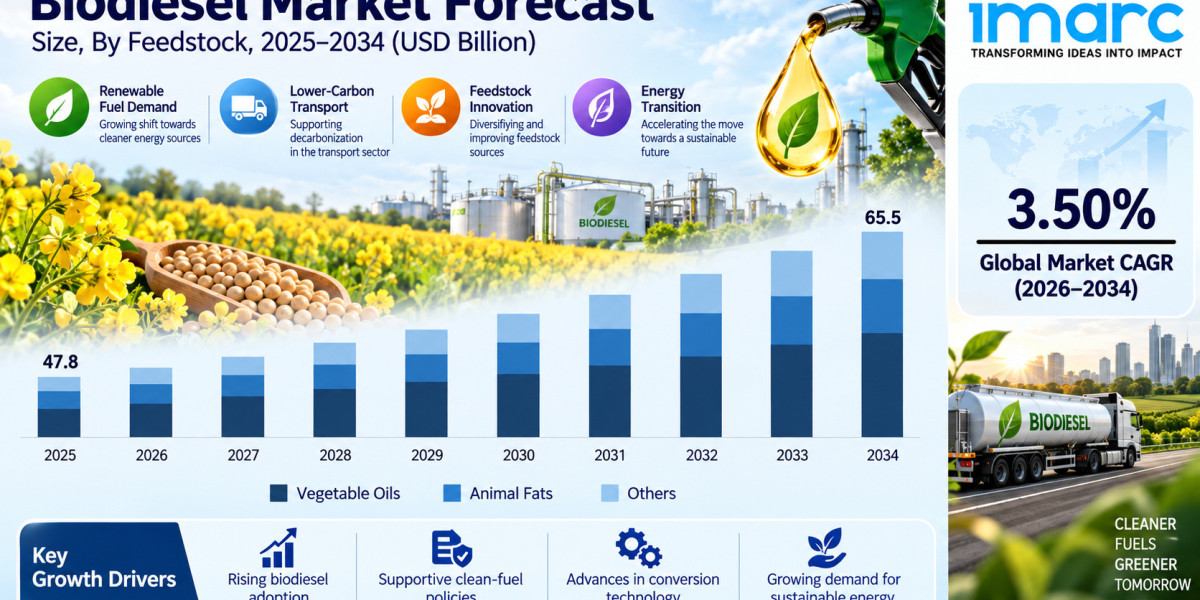

The global biodiesel market size is experiencing steady growth as governments, businesses, and consumers increasingly prioritize renewable energy, energy security, and lower-carbon fuel alternatives. The market reached USD 47.8 Billion in 2025 and is estimated to reach USD 49.9 Billion in 2026. Looking forward, IMARC Group projects the market to reach USD 65.5 Billion by 2034, expanding at a CAGR of 3.50% during 2026–2034. Europe dominated the market in 2025, accounting for 47.8% of the global market share.
The industry is being influenced by government policies supporting renewable energy, concerns about energy security and oil price volatility, technological advancements in production processes, and growing environmental awareness. Expanding biodiesel blending mandates, the development of alternative feedstocks, and increasing investment in sustainable fuel technologies are also creating opportunities across the global energy sector.
What Is Driving Biodiesel Market Growth?
Government Regulations and Renewable Energy Policies
Government regulations and renewable energy policies are among the primary factors supporting the growth of the global biodiesel market. Countries worldwide are introducing blending mandates, tax incentives, subsidies, and other measures to encourage the use of renewable fuels and reduce dependence on conventional petroleum products.
In the United States, the Environmental Protection Agency's Renewable Fuel Standard (RFS) promotes the incorporation of renewable fuels, including biodiesel, into transportation fuel supplies. Similar policy initiatives across international markets are encouraging producers to expand capacity and invest in advanced production technologies.
Europe is also supporting biodiesel adoption through renewable energy policies and emissions reduction objectives. These initiatives are encouraging the development of alternative fuels, greater use of sustainable feedstocks, and improvements in production efficiency.
Government support can provide greater certainty for producers, distributors, and investors by establishing demand for renewable fuels. As countries pursue climate objectives and energy diversification, biodiesel is expected to remain an important component of their renewable energy strategies.
Energy Security and Oil Price Volatility
Growing concerns about energy security and fluctuations in international crude oil prices are encouraging the adoption of biodiesel as an alternative to conventional petroleum-based fuels. Biodiesel can be produced domestically from vegetable oils, animal fats, and used cooking oils, helping countries diversify their energy supplies and reduce exposure to imported fossil fuels.
Geopolitical tensions, supply disruptions, and unpredictable oil prices have highlighted the importance of alternative energy sources. Domestic biodiesel production can support fuel diversification while creating opportunities for agricultural producers, feedstock suppliers, and renewable energy companies.
The supplied report indicates that biodiesel production profitability has fluctuated considerably during the renewable diesel boom of 2021–2024. Production margins moved from average losses of USD 0.59 per gallon during the early phase of the boom to average gains of USD 0.41 per gallon during its middle phase, before returning to average losses of USD 0.19 per gallon from mid-2023 onward.
These fluctuations highlight the importance of feedstock costs, crude oil prices, policy incentives, and market conditions in determining the profitability of biodiesel production.
Biodiesel is also gaining attention in transportation, agriculture, marine applications, and industrial operations. Its potential to diversify fuel supplies and support lower-carbon energy transitions is contributing to growing interest among governments and energy companies.
Technological Advancements and Feedstock Availability
Technological innovation and access to suitable raw materials are important drivers of biodiesel market growth. Improvements in catalysts, conversion processes, feedstock pretreatment, and production systems are helping manufacturers improve yields, manage costs, and expand the range of materials that can be converted into biodiesel.
Traditional biodiesel production relies heavily on vegetable oils, including soybean, rapeseed, palm, and sunflower oils. However, growing interest in sustainable production is encouraging the use of animal fats, used cooking oils, non-food biomass, and other alternative feedstocks.
According to the US Energy Information Administration data cited in the supplied report, biodiesel production in the United States used more than 1,176 million pounds of feedstocks in December 2020, with soybean oil accounting for 744 million pounds.
Expanding feedstock options can help producers manage agricultural supply fluctuations and reduce dependence on food-grade oils. Waste-derived feedstocks, particularly used cooking oil, also support circular economy initiatives by converting waste materials into useful energy products.
Continued investment in production technology, feedstock collection, and processing infrastructure is creating opportunities to improve biodiesel availability and strengthen the industry's long-term sustainability.
Request a Sample Report: https://www.imarcgroup.com/biodiesel-market/requestsample
Biodiesel Market Trends to Watch
Three major trends are shaping the future of the global biodiesel industry.
Renewable fuel mandates and policy support: Governments are encouraging biodiesel consumption through blending requirements, renewable energy targets, tax incentives, and emissions reduction policies. These measures are supporting demand and encouraging investment in production capacity.
Alternative feedstocks and circular economy models: Producers are increasingly exploring used cooking oils, animal fats, non-food biomass, and other alternative materials. These resources can diversify feedstock supplies and support more efficient resource utilization.
Production technology and process innovation: Advances in catalysts, feedstock processing, and conversion methods are helping manufacturers improve production efficiency and explore new applications. Continued research into alternative feedstocks is also supporting the development of more sustainable biodiesel pathways.
The growing emphasis on lower-carbon transportation and industrial energy is creating further opportunities. Biodiesel can be integrated into existing diesel fuel systems through appropriate blends, making it a potential option for fleets and operations seeking to diversify their fuel supplies without completely replacing existing infrastructure.
However, market participants must also navigate feedstock price volatility, regulatory differences, production economics, and sustainability requirements.
Biodiesel Market Segmentation
The global biodiesel market is analyzed by feedstock, application, type, and production technology. Each segment reflects different production methods, fuel requirements, and market opportunities.
By Feedstock
Vegetable Oils
Animal Fats
Others
Vegetable oils dominated the feedstock segment in 2025, accounting for approximately 96.7% of the market. Their leading position is supported by established supply chains, widespread availability, and compatibility with existing biodiesel production systems.
Common vegetable oil feedstocks include soybean, rapeseed, palm, and sunflower oils. Their established role in biodiesel manufacturing allows producers to use existing processing infrastructure and benefit from familiar sourcing arrangements.
Government incentives and renewable fuel policies have also supported vegetable oil-based biodiesel production in several markets. In addition, ongoing technological improvements are helping manufacturers enhance conversion efficiency and optimize production costs.
Nevertheless, the dependence on vegetable oils can expose producers to agricultural price fluctuations and food-versus-fuel concerns. This is encouraging greater interest in alternative feedstocks, including animal fats, used cooking oils, and non-food biomass.
The expansion of alternative feedstock supplies may help diversify production and support the industry's long-term sustainability objectives.
By Application
Fuel
Power Generation
Others
Fuel dominated the application segment in 2025, accounting for approximately 78.7% of the biodiesel market. Its leading position reflects the extensive use of biodiesel in transportation and the influence of government blending mandates.
Many countries encourage or require biodiesel blending with conventional diesel to support renewable energy adoption and reduce the environmental impact of transportation fuels. Biodiesel is used in applications involving commercial fleets, road transportation, agricultural machinery, and other diesel-powered equipment.
Its compatibility with existing diesel infrastructure, subject to appropriate fuel specifications and blend requirements, supports adoption across established distribution networks.
The segment also benefits from growing interest in fuel diversification and lower-carbon alternatives. Improvements in production efficiency and distribution systems are helping expand access to biodiesel blends.
Power generation represents another application opportunity, particularly where biodiesel can support renewable energy objectives or provide an alternative fuel for suitable diesel-powered generators. Industrial and specialized applications may also contribute to future market development.
By Type
B100
B20
B10
B5
B100 led the type segment in 2025, according to the supplied market assessment. B100 refers to fuel containing 100% biodiesel, distinguishing it from blends that combine biodiesel with conventional petroleum diesel.
Its market position is associated with demand for renewable fuel products and policies that encourage higher renewable content in suitable applications. B100 can be relevant to specific fleets, industrial operations, and other users with compatible equipment and fuel-handling systems.
However, the suitability of B100 depends on engine specifications, manufacturer recommendations, climate conditions, fuel quality, and storage requirements. These factors influence its adoption across different applications.
B20, B10, and B5 represent blends containing 20%, 10%, and 5% biodiesel, respectively. These blends allow users to incorporate biodiesel into conventional diesel supplies at different concentrations.
The availability of multiple blend options enables fuel suppliers and end users to select products that align with applicable standards, equipment requirements, and operational needs.
By Production Technology
Conventional Alcohol Trans-esterification
Pyrolysis
Hydro Heating
The supplied market assessment identifies pyrolysis as the leading production technology segment in 2025.
Pyrolysis involves the thermal decomposition of organic materials under controlled conditions and can process various feedstocks, including biomass and certain waste materials. Its potential to convert diverse raw materials into useful energy products has attracted interest as part of broader waste-to-energy and circular economy initiatives.
The technology offers opportunities to diversify feedstock supplies and reduce reliance on selected agricultural commodities. However, the precise process, output, and economics depend on the feedstock and system design. Pyrolysis-derived products may also require additional processing to meet biodiesel specifications, so the technology should not be assumed to be interchangeable with conventional biodiesel production.
Conventional alcohol trans-esterification is an established method for converting oils and fats into fatty acid esters, which are commonly used as biodiesel. Its widespread use is supported by established production practices and compatibility with a range of vegetable oils and animal fats.
Hydro heating, as listed in the supplied report, represents another production technology category within the market segmentation. Continued technological development across production pathways is creating opportunities to improve efficiency and expand the use of alternative raw materials.
Regional Biodiesel Market Outlook
Europe
Europe accounted for 47.8% of the global biodiesel market in 2025, making it the leading regional market. Its position is supported by renewable energy policies, emissions reduction targets, established agricultural supply chains, and developed biodiesel production and distribution infrastructure.
The European Union's renewable energy framework has encouraged the adoption of renewable fuels in transportation. Biodiesel is contributing to these objectives by providing an alternative to conventional petroleum diesel in suitable applications.
Rapeseed oil has historically been an important feedstock in the region, while animal fats and used cooking oils are contributing to efforts to diversify feedstock supplies. Growing interest in waste-derived materials also supports circular economy objectives.
Government incentives, blending requirements, and investments in production technology are supporting market development. At the same time, producers must manage feedstock availability, sustainability requirements, and competition from other renewable fuel pathways.
Europe's established regulatory framework and infrastructure continue to support its leading role in the global biodiesel industry.
North America
North America is an important biodiesel market, supported by renewable fuel policies, incentives, technological innovation, and growing demand for alternative transportation fuels.
The United States represents a major contributor to regional activity. The Renewable Fuel Standard and state-level programs, including California's Low Carbon Fuel Standard, have helped create incentives for renewable fuel production and consumption.
According to IEA Bioenergy data cited in the supplied report, US biofuel production capacity reached 23.8 billion gallons per year in 2023, an increase of more than 1.7 billion gallons compared with 2022. This figure relates to biofuels overall rather than biodiesel alone.
Biodiesel demand is supported by transportation, commercial fleets, agricultural equipment, and industrial applications. Producers are also investing in alternative feedstocks and production improvements to respond to changing policy requirements and market conditions.
In January 2024, the US Department of Agriculture awarded USD 19 million in grants across 22 states to expand biofuel access, according to the supplied report. Initiatives of this kind can support distribution infrastructure, rural economic activity, and access to renewable fuels.
Asia Pacific
The Asia Pacific biodiesel market is supported by rising energy demand, government blending policies, expanding transportation activity, and growing environmental awareness.
Indonesia and Malaysia are important producers of palm oil and have developed biodiesel industries that use this feedstock. Indonesia's biodiesel blending program has been a significant driver of domestic demand, encouraging production and consumption within the transportation sector.
India is also exploring opportunities to expand biodiesel production using locally available feedstocks, including non-edible oils and used cooking oils. These initiatives can support energy diversification while creating potential benefits for waste management and domestic resource utilization.
China and other regional economies are investing in energy technologies and exploring alternative fuels to support their energy and environmental objectives. Growing urbanization and industrialization are further strengthening the need for diversified energy supplies.
The region's future development will depend on feedstock availability, policy implementation, production economics, and the development of collection and distribution infrastructure.
Latin America
Latin America's biodiesel market is supported by agricultural resources, government policies, and the availability of vegetable oil feedstocks.
Brazil is a major biodiesel producer in the region, with soybean oil playing an important role in production. Government blending requirements support domestic consumption, while the country's established agricultural sector provides a substantial foundation for feedstock supply.
Argentina is also an important participant in the biodiesel industry, supported by its soybean production and export-oriented agricultural economy.
The region offers opportunities for rural economic development, agricultural value addition, and investment in biodiesel production facilities. Producers are also exploring improvements in feedstock efficiency and the use of alternative raw materials.
Future market growth will depend on government policies, international trade conditions, agricultural commodity prices, and the economics of producing and distributing biodiesel.
Middle East and Africa
The Middle East and Africa biodiesel market presents opportunities through energy diversification, agricultural development, waste management, and growing interest in renewable energy.
Some countries are exploring biodiesel production using locally available feedstocks, including vegetable oils and used cooking oils. Converting waste oils into fuel can support resource efficiency while helping reduce the environmental impact associated with improper waste disposal.
In South Africa, biodiesel initiatives have explored feedstocks such as sunflower and canola oil. Across the Middle East, broader sustainability and energy diversification programs are encouraging interest in alternative fuel technologies.
Agriculture, mining, logistics, and transportation may offer potential applications where biodiesel is technically suitable and economically competitive.
However, the region's market development depends on feedstock availability, infrastructure investment, supportive policies, and the ability to establish commercially viable production systems.
Key Regional Takeaways
United States Biodiesel Market Analysis
According to the supplied report, the United States accounted for 90% of the North American biodiesel market in 2025. Government policies supporting renewable energy and emissions reduction are important factors shaping demand.
The Renewable Fuel Standard provides a policy framework for renewable fuel use, while state-level initiatives such as California's Low Carbon Fuel Standard encourage lower-carbon transportation fuels.
The US biodiesel industry benefits from an established agricultural sector, particularly soybean production, which supplies an important feedstock for biomass-based diesel. Corn and canola oils also contribute to feedstock availability.
Commercial fleets, transportation operators, and industrial users are exploring biodiesel blends as part of broader fuel diversification strategies. Investments in production technologies and alternative feedstocks are helping companies respond to changing market conditions.
However, the market remains sensitive to agricultural commodity prices, regulatory changes, and the economics of converting feedstocks into finished fuel.
North America Biodiesel Market Analysis
The North American biodiesel market is influenced by environmental regulations, renewable fuel standards, tax incentives, and demand for lower-carbon energy alternatives.
Public-sector support and private investment are helping expand biofuel infrastructure and improve production capabilities. The availability of vegetable oils and animal fats provides a foundation for production, while research into alternative feedstocks may help diversify supply.
Transportation and industrial applications remain important sources of demand. Commercial fleets and other diesel users can incorporate suitable biodiesel blends into their fuel strategies, subject to applicable technical requirements.
Continued investment in feedstock processing, distribution networks, and production technology is expected to remain important for the regional market.
Europe Biodiesel Market Analysis
Europe maintains its leading position in the global biodiesel market, supported by renewable energy policies, established infrastructure, and demand for alternatives to conventional diesel.
The European Union's Renewable Energy Directive has played an important role in shaping renewable energy adoption and transportation fuel policy. The supplied report also cites European Biodiesel Board data indicating that EU biodiesel production, excluding the United Kingdom, reached 13.7 million tonnes in 2022.
Rapeseed oil has historically been an important feedstock, while used cooking oils and animal fats are gaining attention as alternative raw materials.
Europe's focus on energy security, emissions reduction, and circular economy principles continues to encourage investment in biodiesel production and feedstock innovation. Producers must also navigate sustainability criteria, changing regulations, and competition among renewable fuel technologies.
Asia Pacific Biodiesel Market Analysis
The Asia Pacific biodiesel market is supported by government blending programs, energy demand, and the availability of agricultural feedstocks.
Indonesia and Malaysia play important roles in palm oil production and biodiesel manufacturing. Domestic blending policies have helped create demand for biodiesel and encouraged investment in production infrastructure.
India is exploring the use of non-edible oils and used cooking oils to support renewable fuel production. These initiatives can help diversify energy supplies and create opportunities for waste collection and processing businesses.
Regional partnerships and technology development may further support the adoption of biodiesel. However, feedstock costs, sustainability considerations, and collection infrastructure will influence the pace of market expansion.
Latin America Biodiesel Market Analysis
Latin America's biodiesel market benefits from established agricultural production, particularly soybean cultivation in Brazil and Argentina.
Brazil's domestic blending requirements support biodiesel consumption, while its agricultural sector provides an important source of feedstock. Argentina's production and export capabilities also contribute to the region's position in the international market.
Opportunities exist in production efficiency, agricultural supply chain development, and the use of alternative feedstocks. Investment in technology and infrastructure can help improve competitiveness and strengthen the industry's contribution to renewable energy objectives.
Middle East and Africa Biodiesel Market Analysis
The Middle East and Africa region is exploring biodiesel as part of broader energy diversification and sustainability initiatives.
South Africa has investigated biodiesel production using agricultural oils, while some countries in the Middle East are exploring opportunities associated with used cooking oil collection and renewable energy development.
Agriculture, logistics, mining, and industrial operations may provide potential demand for suitable biodiesel products. However, expansion depends on reliable feedstock supplies, production economics, infrastructure, and regulatory support.
Competitive Landscape
The global biodiesel market includes established energy companies, agricultural processors, renewable fuel producers, and specialized technology providers. Companies compete through production capacity, feedstock sourcing, operational efficiency, technology development, strategic partnerships, and access to regional markets.
Leading producers are investing in production improvements and exploring alternative feedstocks to strengthen supply chains and manage costs. Partnerships between energy companies, agricultural businesses, waste collection operators, and fuel distributors are also helping develop integrated renewable fuel systems.
The industry is increasingly focused on circular economy initiatives, including the conversion of used cooking oil and other waste materials into renewable fuels. These approaches can create additional feedstock sources while supporting resource efficiency.
In September 2024, Chevron, Restaurant Technologies, and Sheetz collaborated on an initiative to recycle used cooking oil into biodiesel. The partnership demonstrated how businesses from different sectors can work together to convert waste into fuel and support lower-carbon energy pathways.
Major companies identified in the global biodiesel market include:
Archer Daniels Midland Company (ADM)
Wilmar International Limited
Renewable Energy Group Inc.
Bunge Limited
Cargill, Incorporated
Neste Oyj
Louis Dreyfus Company B.V.
Biox Corporation
Diester Industrie
Biomass Technology Group (BTG) BV
DuPont
POET
Verbio Vereinigte BioEnergie AG
China Clean Energy, Inc.
CropEnergies AG
INEOS AG
Recent Industry Developments
August 2024: Gunvor Group acquired a 50% share in VARO Energy's Rotterdam Sustainable Aviation Fuel project, supporting the development of low-carbon fuels for aviation. The investment reflects broader industry interest in sustainable fuel production and transportation decarbonization.
June 2024: Bunge agreed to sell its 50% share in bp Bunge Bioenergia to bp, which would make bp the sole owner of the Brazilian biofuels business. The transaction was intended to strengthen bp's position in the biofuels industry.
July 2023: Cargill partnered with TREES Consulting to develop a methodology providing the beef industry with a framework for assessing methane emissions. The initiative reflected broader efforts to measure and address emissions across agricultural supply chains.
July 2023: Wilmar International divested its interest in the sugar business Cosumar, representing a portfolio development within the broader agricultural and commodity sector.
June 2021: Bunge entered into a merger arrangement with Glencore-backed interests, as described in the supplied report, in a move associated with consolidation in the agricultural trading industry.
Where Are the Biggest Biodiesel Market Opportunities?
The global biodiesel industry presents opportunities across several areas:
Alternative feedstocks: Used cooking oils, animal fats, algae, and non-food biomass can help diversify raw material supplies and reduce reliance on conventional vegetable oils.
Advanced production technologies: Improved catalysts, processing systems, and feedstock pretreatment methods can help enhance production efficiency.
Renewable fuel policies: Blending mandates, tax incentives, and renewable energy targets can support demand and encourage investment.
Transportation and commercial fleets: Suitable biodiesel blends can help diesel users diversify fuel supplies and support emissions reduction strategies.
Marine applications: Biodiesel may provide opportunities in suitable marine engines and fuel systems as operators evaluate alternative fuels.
Power generation: Compatible biodiesel products may support selected diesel-powered generators and other energy applications.
Waste-to-fuel initiatives: Collecting and processing used cooking oil can turn waste materials into valuable fuel feedstocks.
Agricultural development: Biodiesel production can create opportunities for farmers, feedstock processors, and rural supply chains.
International partnerships: Collaboration among energy companies, agricultural businesses, technology providers, and distributors can strengthen production and market access.
These opportunities are particularly relevant as governments and industries seek to diversify energy supplies and reduce the environmental impact of fuel consumption. Companies that combine reliable feedstock sourcing with efficient production, regulatory compliance, and strong distribution networks can strengthen their competitive position.
Get Detailed Biodiesel Market Intelligence
The headline market figures provide a useful overview of the industry's direction, but businesses evaluating market entry, production investments, feedstock sourcing, technology development, or regional expansion may require more detailed market intelligence.
A comprehensive biodiesel market report can help businesses assess:
Market size and growth forecasts
Feedstock-wise market segmentation
Application-wise market performance
Biodiesel type analysis
Production technology assessment
Regional and country-level market opportunities
Government policies and renewable fuel mandates
Feedstock availability and cost trends
Competitive landscape and key company profiles
Technological advancements and industry developments
Emerging opportunities in transportation, power generation, and industrial applications
Access to detailed market insights can support strategic decisions involving production capacity, feedstock procurement, technology investments, and expansion into high-potential markets.
Request a Sample Report: https://www.imarcgroup.com/biodiesel-market/requestsample
Biodiesel Market FAQs
What is the current size of the global biodiesel market?
The global biodiesel market reached USD 47.8 Billion in 2025 and is estimated to reach USD 49.9 Billion in 2026. It is projected to reach USD 65.5 Billion by 2034.
What is the expected CAGR of the biodiesel market?
The global biodiesel market is projected to expand at a CAGR of 3.50% during 2026–2034.
Which region leads the biodiesel market?
Europe led the global biodiesel market in 2025, accounting for 47.8% of the market share. Renewable energy policies, emissions reduction objectives, established production infrastructure, and demand for alternative fuels support its leading position.
Which feedstock segment dominates the biodiesel market?
Vegetable oils dominated the feedstock segment in 2025, accounting for approximately 96.7% of the market. Their established supply chains and compatibility with biodiesel production processes support their widespread use.
Which application dominates the biodiesel market?
The fuel segment represented approximately 78.7% of the biodiesel market in 2025. Demand is supported by renewable fuel mandates, transportation requirements, and the use of biodiesel blends in suitable diesel applications.
Which type leads the biodiesel market?
B100 led the type segment in 2025, according to the supplied market assessment. B100 contains 100% biodiesel and is used in applications where the fuel meets the relevant engine, equipment, and fuel-handling requirements.
What are the major trends in the biodiesel market?
Key trends include renewable fuel mandates, alternative feedstock development, technological improvements, used cooking oil recycling, circular economy initiatives, and increasing interest in energy security and lower-carbon fuels.
Who are the major companies in the biodiesel market?
Major companies include Archer Daniels Midland Company, Wilmar International, Renewable Energy Group, Bunge, Cargill, Neste, Louis Dreyfus Company, Biox Corporation, Verbio Vereinigte BioEnergie, POET, CropEnergies, and INEOS.
Conclusion
The global biodiesel market is evolving as governments, energy companies, and consumers increasingly focus on renewable fuels, energy security, and emissions reduction. Valued at USD 47.8 Billion in 2025, the market is projected to reach USD 65.5 Billion by 2034, registering a CAGR of 3.50% during 2026–2034.
Growth opportunities are emerging across vegetable oil-based biodiesel, waste-derived feedstocks, transportation fuels, alternative production technologies, and renewable energy infrastructure. Europe maintains its leading position, while North America, Asia Pacific, and Latin America offer opportunities associated with policy support, agricultural resources, and expanding demand for alternative fuels.
Companies that invest in efficient production, diversified feedstock supplies, technology innovation, and strategic partnerships can strengthen their competitive positioning in the evolving biodiesel industry.
About the Author
IMARC Group is a global market research company providing data-driven insights and expert consulting services to businesses seeking to achieve their strategic objectives. With a multidisciplinary team of industry experts, IMARC delivers market intelligence across sectors including energy and mining, construction and manufacturing, automotive, chemicals and materials, and more.
Media & Sales Contact
IMARC Group
United States: +1-201-971-6302
India: +91-120-433-0800
United Kingdom: +44-753-714-6104